
On 22 August a humanoid robot ran 100 metres in 9.39 seconds at an arena in Beijing. Usain Bolt’s world record, set in 2009 and untouched since, is 9.58 seconds.
That sentence has been around the world this week, and it is true. It is also, by some distance, the least useful thing that happened at the World Humanoid Robot Games. The genuinely interesting numbers were on the same scoreboard and almost nobody printed them.
What actually happened
The second World Humanoid Robot Games opened on 22 August 2026 at the National Speed Skating Oval in Beijing and runs to 26 August. Organisers put the field at 2,056 robots from 666 teams, drawn from 16 countries and regions across six continents, competing in 51 events and roughly 1,300 individual matches, according to CGTN.
In the 100 metres, Tiangong Ultra — built by the Beijing Humanoid Robot Innovation Center, which trades as X-Humanoid — won its heat in 9.39 seconds. Lightning, entered by the smartphone maker Honor, finished the same heat in 9.47 seconds. Both are inside Bolt’s mark. A Unitree Robotics entry ran 12.41 seconds, as the South China Morning Post reported. In the standing high jump, Xinhua records Tiangong Ultra at 2.8843 metres, against a human record of 2.45 metres that has stood since 1993.

The number that matters is the gap between two years
Compare the two editions rather than comparing a robot to a man.
At the first games in August 2025, the winning 100 metres time was 21.50 seconds. This year it was 9.39. The best standing high jump last year was 0.95 metres. This year it was 2.88. The field went from around 500 robots and 280 teams to 2,056 robots and 666 teams — a 138% rise in entrants in twelve months.
A machine beating a human sprinter is a category error dressed up as a milestone: different mass, different actuators, no reaction time to lose at the gun, and a track it was purpose-built to run on. Halving a time in one year against your own previous best is not a category error. It is a rate of change, and rate of change is the only thing in this story that lets you plan.
The rule change almost nobody covered
The most consequential thing in the 2026 rulebook is a scoring coefficient.
In the scenario-based events, Xinhua reports that a task completed fully autonomously scores at a coefficient of 1.0, while the same task completed under remote human operation scores 0.5. Half marks for a person in the loop.
That single line reframes the entire event. It says the organisers know the difference between a robot that can do a thing and a robot that can be driven through a thing, and they have decided to price it. Several athletics events — the 400m, the 1,500m and the 4×100m relay — are designated fully autonomous categories in which remote control is not permitted at all.
One honest caveat, because it changes how you should read the headline. Sources do not agree on whether the 100 metres itself was run under full autonomy or still permitted remote operation. Some reporting describes the sprint as newly autonomous this year; Xinhua’s account of the rules lists the 100m among the events where remote operation is still allowed. We could not resolve that from published sources, so we are not going to pretend it is settled. If the sprint was teleoperated, the record is a statement about hardware and control latency, not about machine autonomy — and those are very different claims.
Twenty-one of the fifty-one events were work
Of the 51 events, 30 were competitive sport and 21 were scenario-based: not races, but jobs.
Xinhua’s account of them reads like a shift rota. Gripping snacks with tongs. Setting a microwave timer to within a minute. Carrying drinks without slopping them. Moving luggage of different sizes, restocking a guest room, making a bed inside a thirty-minute window. Assembly work, shelf restocking, order packing, returning misplaced items to the right shelf. Sorting library books. Firefighting and rescue drills.
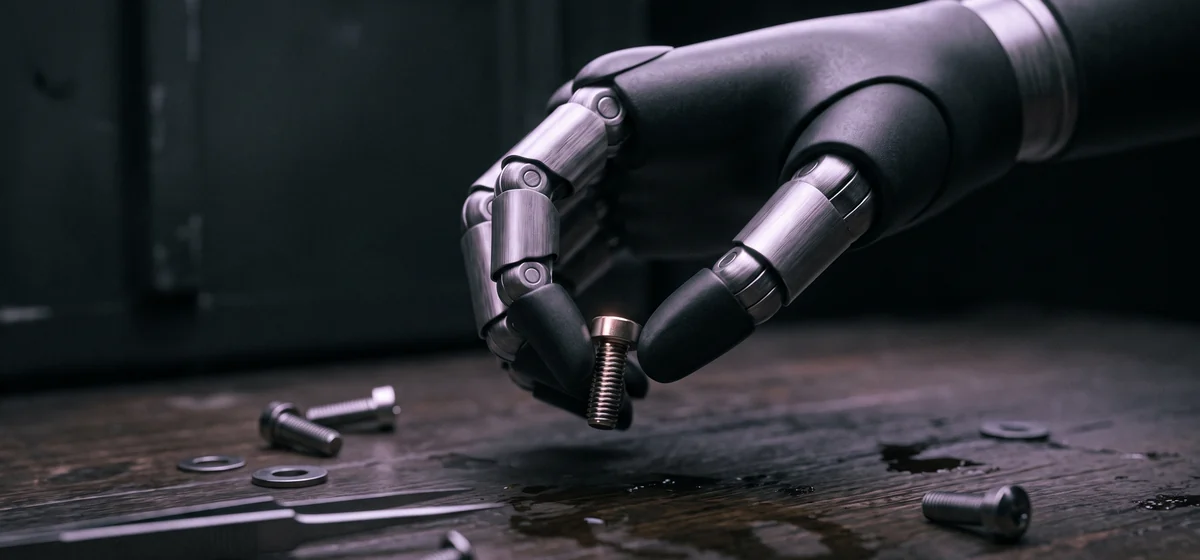
There is also a dexterity challenge of eight precision tasks — assembling with a power tool, picking beans up with tweezers, weighing powder, removing a bottle cap, connecting a flexible cable. Judges score task completion, collision avoidance and how smoothly the whole thing was done.
Read that list again as a list of jobs and the event stops looking like a sports day. Hotels, supermarkets, warehouses, factories, emergency response. The sprint sells the tickets; the bed-making is the product roadmap.
What the engineers themselves say
The most grounded quote of the week came from the team that set the record. Guo Yijie, technical lead on Tiangong Ultra, told Xinhua:
“The real challenge lies in turning peak performance into consistent reliability, while high-speed, long-distance running will expose structural fatigue, joint cooling, and drivetrain durability issues that must be addressed for long-term deployment.”
That is the person who built the fastest robot at the games telling you the record is not the point. A peak is one good run. A product is ten thousand mediocre ones without a failure.
Wang Xingxing, founder of Unitree Robotics, named the constraint from the other end: the industry’s problem is limited generalisation — a machine that handles the task it was trained on and falls over on the one next to it. He put a breakthrough that would let robots handle roughly 80% of everyday tasks somewhere between two and ten years out. That is an eight-year error bar from one of the field’s most bullish figures, and it is worth more than any stopwatch.
Reporting across outlets is consistent on the limitation: humanoids today are largely used for demonstration, performance and research, and broad real-world deployment is still ahead.
What this actually means if you run a business
Nothing about your operations changes this quarter because a robot ran 9.39. Here is what we think is worth taking from it.
The demo-to-deployment gap is the whole game, and it is not unique to robots. This is the same gap that swallows most business AI projects. A model does something impressive in a controlled setting; the thing that never arrives is reliability under the conditions of an actual Tuesday. Every serious question about automation is a question about the boring 5% of cases, not the exciting 95%. We wrote about how to structure that for software agents in AI agents, and the governance that makes them safe to deploy.
Autonomy scoring is a good procurement instinct. The organisers scored a supervised task at half the value of an unsupervised one. That is a defensible way to evaluate any automation you are being sold: what does this do when nobody is watching it, and what does it cost you in attention? A tool that needs a person hovering over it has not removed the work — it has changed who does it and added a handover.
Be careful with the number in the press release. A peak benchmark quoted without its conditions is the oldest trick in technology marketing, and it is not always dishonest — often the person quoting it simply never asked. Ask what the conditions were, ask what the median looks like, ask what happens on the tenth run. We take the same view of performance claims about websites, which is why our own numbers are published with their method attached in our write-up on frontier AI for UAE businesses.
Watch the scenario events, not the sprint. If humanoid robots reach hotels and warehouses in the Gulf, they will arrive through the bed-making and the shelf-restocking, not the athletics. When a task in that list is completed autonomously, repeatedly, by more than one team, that is the signal worth acting on.
One more year of this is worth watching
A field that quadrupled in a year is telling you something regardless of what you think of the marketing around it. Chinese-built units accounted for more than 97% of roughly 19,100 humanoid robots shipped globally in the first half of 2026, according to figures from Smart Analytics Global cited by Xinhua — a concentration worth knowing about if you are ever specifying this kind of hardware.
But the honest summary of Beijing 2026 is not “robots beat Usain Bolt”. It is: a field of research machines got dramatically better at moving in twelve months, started being scored on whether it can work unsupervised, and its own lead engineers say reliability, not speed, is the unsolved problem.
That is a less exciting headline. It is a far more useful one.
We build websites, platforms and AI automation for businesses in Dubai and across the GCC — and we are equally happy telling you when automation is the wrong answer. If you want a scoped, itemised estimate rather than a number in a deck, see how we price or tell us what you are building.
Sources for every figure in this article are listed in the post metadata and linked inline. Where outlets disagreed, the disagreement is stated rather than resolved. This article takes no position on national industrial policy and none of the figures here are our own measurements.